

Test post title
Coaches trying to teach Tiki Taka often admire the aesthetics—short passes, tight angles, relentless movement—while missing the practical adjustments that make it repeatable in matches. This article focuses on five specific coaching mistakes that interrupt possession-based play and gives clear, actionable fixes you can put into training that week.
1. Teaching patterns, not principles
Mistake: Rehearsing a set sequence of passes until players memorize the pattern. When the opponent changes shape the pattern breaks and so does confidence.
Fix: Teach principles—support angles, spacing, timing, and when to switch the ball—through constrained rondos where stimuli change each repetition. Ask players to name the principle they used after each rep (e.g., “third-man run” or “create an overload”). That reflection builds decision-making, not rote memory.
2. Neglecting body orientation and first touch
Mistake: Coaches focus on where the ball goes and ignore how players receive it. A poor first touch or bad body angle converts a planned sequence into a contested duel.
Fix: Add 50–100 short touches per session with immediate pressure. Use drills where the receiver must open their body within one touch and pass to a pre-determined target. Progress by forcing the next action to be either forward or diagonal; this creates repeatable habits under pressure.
3. Over-coaching in live play
Mistake: Constant shouts and corrections during scrimmages stop natural flow and reduce player autonomy.
Fix: Reserve live-game intervention to 1–2 high-value inputs. Use halftime to correct patterns and ask players to set two team objectives for the next period (e.g., “keep five consecutive passes”, “switch field once”). Players internalize goals better than instructions shouted from the touchline.
4. Ignoring transitions and recovery runs
Mistake: Focusing only on possession phases and forgetting how to regain the ball or re-organize after loss.
Fix: Integrate conditioned games where losing possession triggers a 6-second counter-press. Reward successful counter-presses with numerical advantages. This trains players to expect turnovers and to make immediate recovery runs that re-establish compactness.
5. One-size-fits-all roles
Mistake: Assigning positions rigidly and forcing wide players to behave like central playmakers or vice versa.
Fix: Define role clusters (ball-carrier, support runner, depth provider) and rotate players through them during training. Use small-sided games that require each player to perform a different role for two minutes. That builds versatility and helps you spot which players suit which tactical responsibilities.
Putting it together on the training ground
Session structure: 15 minutes technical touches (body orientation), 20 minutes principle-based rondos, 15 minutes transition drills, 20 minutes conditioned scrimmage with limited coaching interventions. Finish with a short video review of one successful sequence. Use the image and the short clip below to show how spacing and the third-man run create openings in practice.
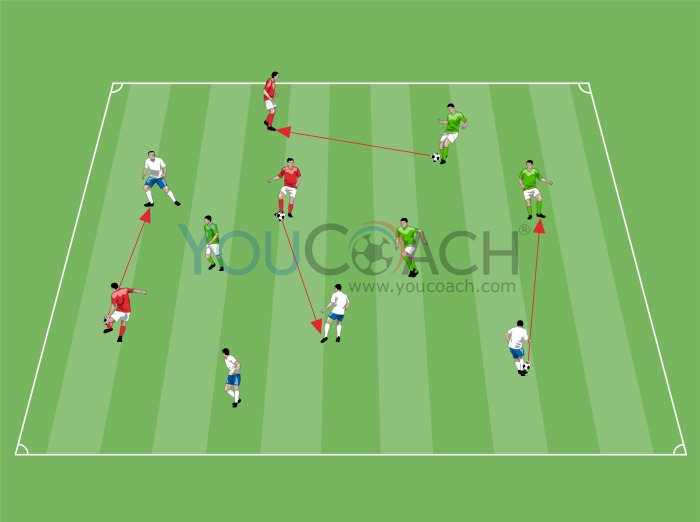
Coach the principles, train decisions under pressure, reward recovery work, and rotate roles. If you do those four things consistently, your team will keep more of the ball and create higher-quality chances. For a quick reference resource and an outside perspective on the culture around this playing style, see Tiki Taka.
Publicaciones Relacionadas